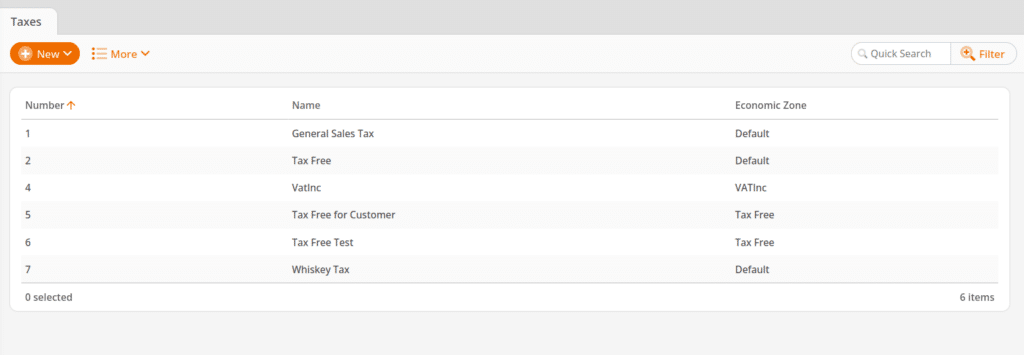
This is where you can set up each individual tax rate, as needed, for the products you are selling. You will need to set up as many taxes as you are going to collect at the point of sale. This can range from a single tax to several, depending on local tax legislation.
Please refer to our Tax Set Up manual page for a full list of instructions to get your taxes set up.
Setting up Taxes
Before you set up your taxes, you will want to set up an Economic Zone. To learn how to do so, please refer to our Economic Zone manual page.
You can configure taxes in your point of sale system by navigating to Settings > Taxes. Here, you will be able to create a New tax and Edit or Delete existing taxes. You may even Copy an existing tax for a quicker setup process. From the …More drop down menu, you may view your Tax Report.

Each tax is given a name, assigned to an economic zone, and designated as inclusive or exclusive. The validity rate and date must also be defined.
By default, all tax rates are exclusive unless the “Included” box is checked. If you enable the “Included” option, the POS will calculate the tax assuming it is included in the retail price. This means the total will not increase for the customer. However, your business’s net revenue will decrease. This setting usually makes sense if including the tax is required by the local government or for cash-only businesses that do not want to avoid dealing with change.

Each tax applies to one economic zone.
Upcoming tax rate changes can be set in advance using the valid-from date.
After the tax rates are set, proceed to set up the Sectors.
Multiple Tax Rate Set-Up
If you have taxes that need to be broken out rather than listed cumulatively, you can do so under Taxes as well. You can make multipleTax Rates for the same Economic Zone to help accomplish this.
Here’s an example: Your county charges a 5% liquor tax and a 5% county tax. In some municipalities, they may be fine seeing a total tax of 10% shown on the receipt.
In other situations, they may wish to see what percentage belongs to what particular tax. If that is the case, you could set one tax for liquor and one for county, and then, by adding them to the same Sector, both would apply.